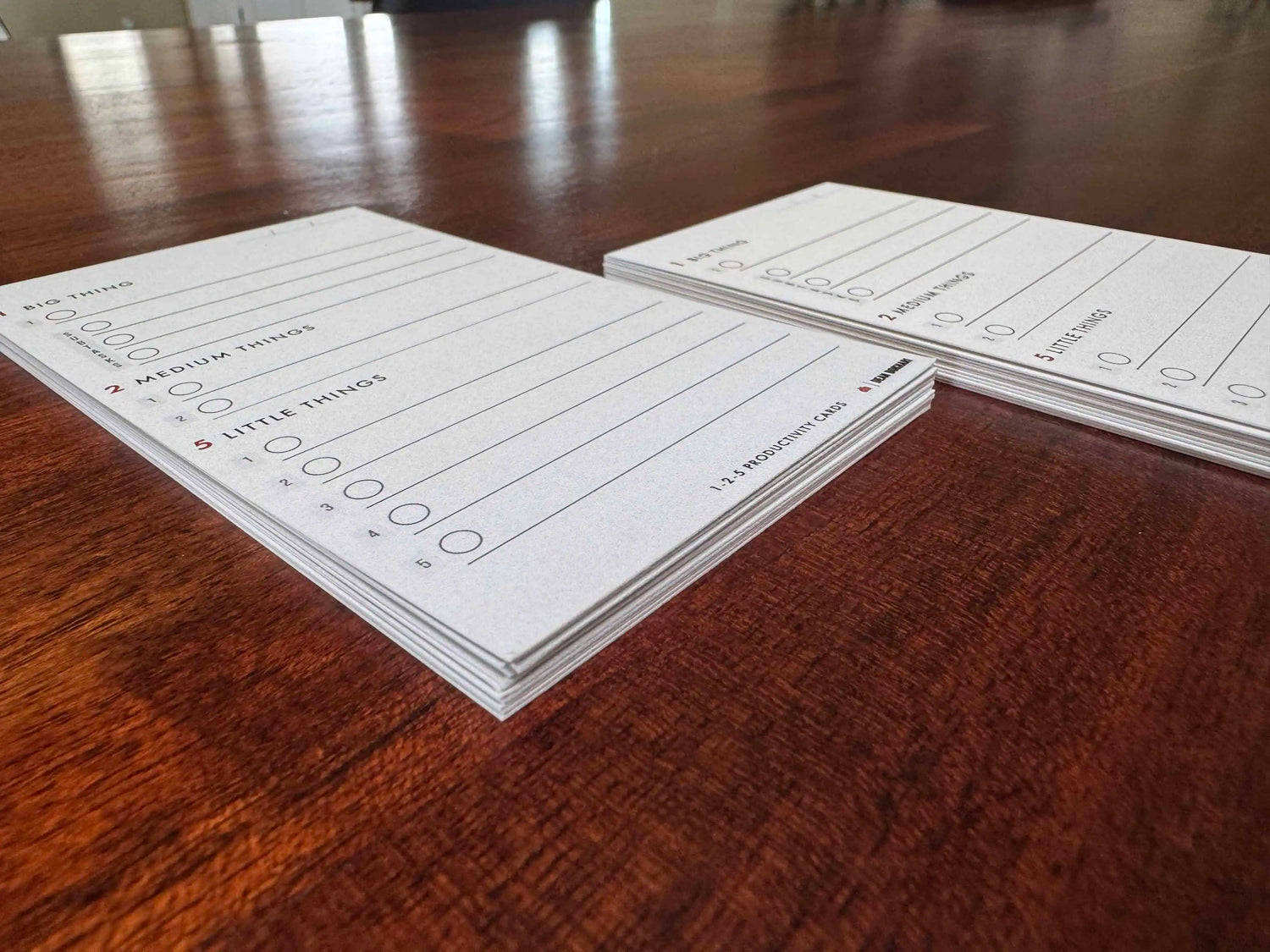
Supporting Research for the 125 Method™

The 1-2-5 Method™ can boost individual and collective productivity by up to 40%.

Internal benchmarking reveals that users of the 1-2-5 Method™ report approximately a 40% increase in productivity (specifically, task completion) compared to traditional unstructured to-do lists.1_2

This finding aligns with decades of peer-reviewed research showing that structured planning, prioritization, and constrained task selection3 significantly improve follow-through and reduce unfinished work.

Bottom line: When you force clear priorities4 and pair them with simple, specific plans, people follow through at meaningfully higher rates.

This results in higher performance and productivity for individuals working alone as well as individuals working collectively (ie, teams, companies, and organizations of all sizes).


Footnotes

  1. Uhlig, Lars, Verena Baumgartner, and Sabine Sonnentag. “A Field Experiment on the Effects of Weekly Planning Behaviour on Work Engagement, Unfinished Tasks, and Cognitive Flexibility.” Journal of Occupational and Organizational Psychology 96, no. 3 (2023): 689–714. https://doi.org/10.1111/joop.12425  ↩

  2. Claessens, Brigitte J. C., Wendelien van Eerde, Christel G. Rutte, and Robert A. Roe. “A Review of the Time Management Literature.” Applied Psychology: An International Review 56, no. 2 (2007): 255–276. https://doi.org/10.1111/j.1464–0597.2006.00255.x  ↩

  3. Gollwitzer, Peter M. “Implementation Intentions: Strong Effects of Simple Plans.” American Psychologist 54, no. 7 (1999): 493–503. https://doi.org/10.1037/0003–066X.54.7.493  ↩

  4. Baumeister, Roy F., and John Tierney. “Decision Fatigue Exhausts Self-Regulatory Resources.” Journal of Personality and Social Psychology 94, no. 5 (2008): 883–898. https://doi.org/10.1037/0022–3514.94.5.883  ↩